


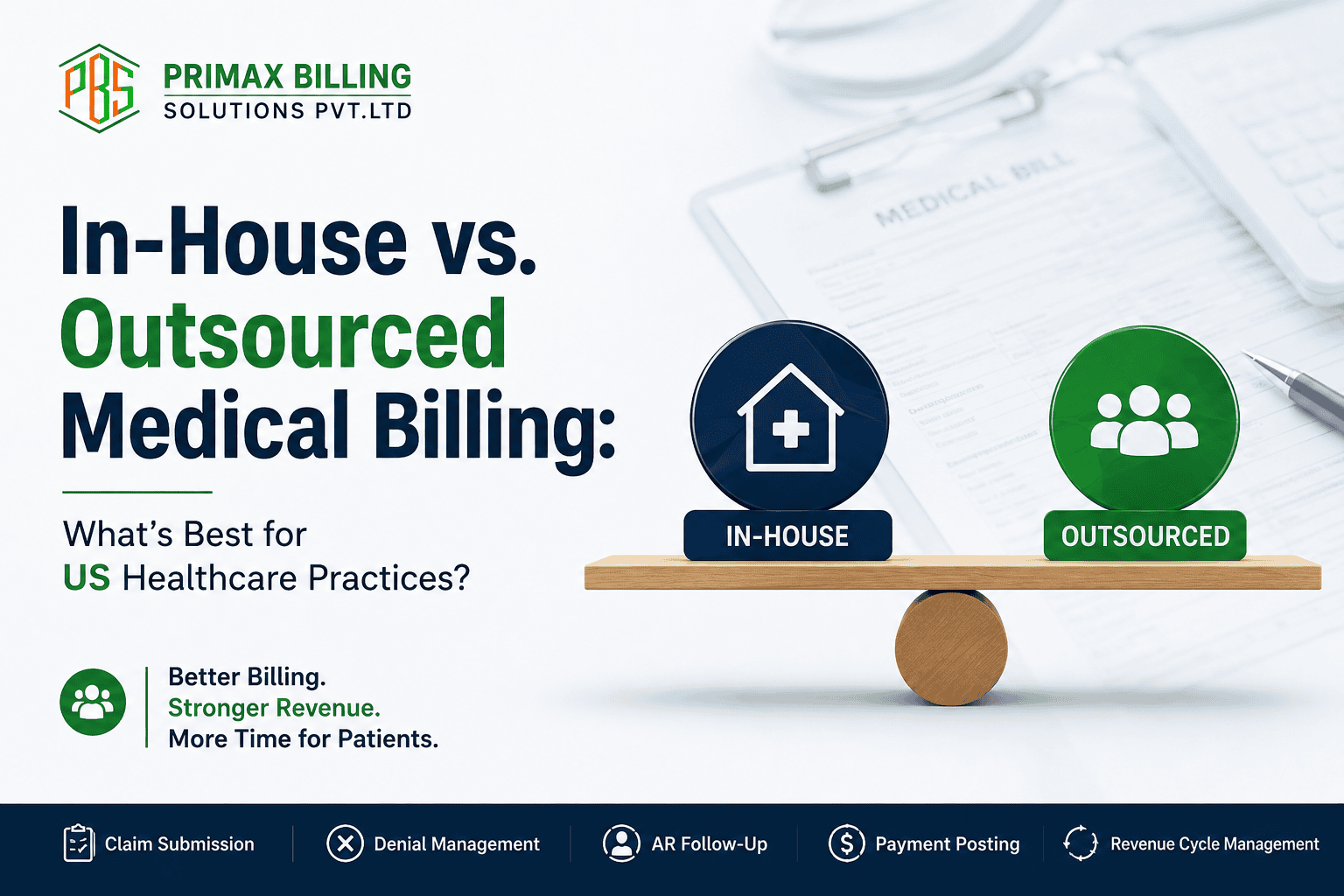
For many healthcare providers, In-House vs. Outsourced Medical Billing: What’s Best for US Healthcare Practices? is an important question. Medical billing involves much more than submitting claims—it includes eligibility verification, coding, claim follow-up, denial management, AR, and payment posting. Managing all these tasks efficiently can have a direct impact on a practice’s revenue.
What Does In-House Medical Billing Mean?
With in-house billing, the practice manages its billing operations using its own employees. This gives the practice direct control, but it also means handling staff hiring, training, billing software, payer requirements, claim follow-up, denials, and AR management.
For small or growing practices, managing all these responsibilities internally can become time-consuming and expensive.
What Does Outsourced Medical Billing Mean?
Outsourced medical billing means working with a professional billing company to manage some or all of your billing and revenue cycle tasks.
Instead of spending hours dealing with unpaid claims and insurance companies, your staff can focus more on patients while an experienced billing team handles the financial side.
Services may include:
- Eligibility and insurance verification
- Claim submission
- Denial management
- AR follow-up
- Payment posting
- Coding support
- Credentialing
- Revenue cycle management
Why Are US Healthcare Practices Outsourcing Billing?
One of the biggest reasons is time and expertise.
Billing teams need to stay updated with payer requirements, claim rules, coding changes, and follow-up processes. When your internal team is already busy, unpaid claims and growing AR can easily get overlooked.
Outsourcing gives practices access to experienced billing professionals without the need to build and manage a large billing department.
How PrimaxBS Supports Healthcare Practices
At Primax Billing Solutions, we understand that medical billing is an important part of running a successful healthcare practice.
Our team supports practices with claim submission, denial management, AR follow-up, payment posting, coding support, credentialing, and other revenue cycle services.
We don’t simply focus on submitting claims. We look at the billing process as a whole, identify areas where payments may be delayed, and help practices maintain a more organized revenue cycle.
Our goal is simple:
Fewer billing headaches. Better follow-up. A healthier revenue cycle.
In-House or Outsourced: Which One Is Better?
There is no single answer for every practice.
In-house billing may work well if you already have an experienced team, proper technology, and enough resources to manage your billing operations.
Outsourcing may be a better option if your practice is dealing with:
- Increasing AR
- Frequent claim denials
- Staffing problems
- Delayed payments
- Billing backlogs
- Heavy administrative work
When comparing In-House vs. Outsourced Medical Billing: What’s Best for US Healthcare Practices?, don’t look at cost alone. Consider experience, communication, technology, reporting, follow-up, and the overall support your billing partner provides.
Let PrimaxBS Help With Your Billing
Your healthcare team should be focused on providing quality patient care—not spending the entire day chasing unpaid claims.
If your practice needs support with medical billing, AR, denial management, or revenue cycle management, PrimaxBS is ready to help.
In-House vs. Outsourced Medical Billing: What’s Best for US Healthcare Practices? Ultimately, the right choice is the one that helps your practice maintain an efficient billing process while allowing your team to focus on what matters most—your patients.
Ready to simplify your medical billing? Contact PrimaxBS today.